Clubs at CERN: Get Involved!
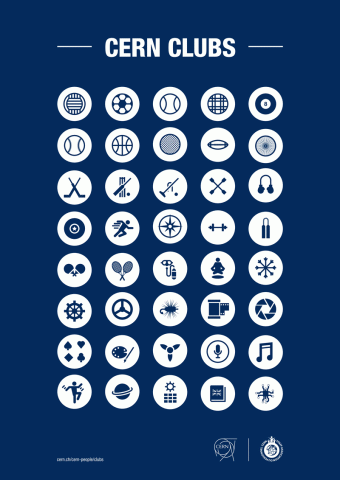
CERN is world-renowned for its major scientific discoveries and impressive infrastructure such as the LHC. Yet beyond the laboratories and accelerators, another dimension contributes to the richness of this institution: its clubs.
True pillars of community life, they play an essential role in maintaining a healthy work-life balance and are key to integrating newcomers, while fostering the creativity of the thousands of people who work on site, as well as their families.
Although CERN was founded in 1954 and the Staff Association in 1955, it is worth noting that the origins of the clubs were directly integrated into the Association through a Sports Commission that brought together various activities such as football, judo, golf, skiing, basketball, and more. Additional activities followed, with the Car Club in 1957 and the Photo Club in early 1958.
That was only the beginning. Without attempting to provide an exhaustive list, other clubs still active today were created, such as the Ski Club CERN in 1963, the CERN Games Club and the Rugby Club CERN in 1965.
Another notable club in terms of integrating spouses and partners was the “Club des Cernoises”, founded in 1974 and renamed the CERN Welcome Club in 2017.
Some clubs were created to follow new trends, as was the case with the CERN Micro Club, founded in 1985 for personal computer enthusiasts during the early days of the Macintosh, Amiga, Commodore, Atari, and IBM PC compatibles.
Other clubs organize events that have become highlights of life at CERN, such as the CERN MusiClub with the Hardronic Music Festival and Music on the Lawn, or the CERN Running Club with the CERN Relay Race. More recently, CinéGlobe has emerged, along with the Film Making Club.
Do not hesitate to consult the current list of clubs on the Staff Association website: https://staff-association.cern/unite/clubs
Many of these long-standing clubs were able, at the time, to benefit from support from CERN’s management in setting up the necessary infrastructure whether car washing and repair facilities, sports fields for cricket, croquet, and softball, or the provision of barracks and other premises spread across the CERN sites.
We should also not forget the annual subsidies provided by CERN and by the Staff Association, which help ensure the smooth running of the clubs.
However, CERN has grown considerably since then, and coexistence has become more complicated due to space constraints. Recently, the Mobility Center was created on the area previously occupied by the pétanque courts, and the construction work on the 777 parking areas now borders very closely (too closely?) the softball and cricket fields.
Some clubs also suffered membership losses during the COVID-19 period, when access to premises was impossible and activities could not continue.
More recently, the transition to WordPress rendered many club websites inoperative, and the lack of volunteers to update and maintain them has become noticeable.
A renewal is therefore needed both from CERN management, in terms of maintaining and refurbishing existing buildings and infrastructure, particularly the club barracks near Entrance A, and from new members, young and less young alike, willing to take on responsibilities within the committees of clubs that interest them. This would bring fresh momentum and allow clubs to reinvent themselves or continue to thrive.
CERN clubs exist for their members but also through their members so get involved!
You can discover some clubs during events such as Connecting the Dots, where stands are set up in front of the Council Chamber during the 3–4 p.m. break (next session on April 29), or during the CERN Relay Race, where clubs have stands in front of Restaurant 1 on the esplanade with the LHC magnet.
Or simply get in touch directly with the club, or via the Clubs Coordination Committee if the club’s website is no longer operational.