
Family Leave Policies in International Organizations: Current Landscape and Proposal for CERN
Family leave policies play a crucial role in supporting staff wellbeing, promoting gender equality, and enabling a healthy work–life balance. In recent years, many international organizations have modernized their parental support frameworks, moving towards more inclusive and flexible systems. A comparative review of maternity, paternity and parental leave policies across major institutions—including ESA, ESO, UNOG, the European Commission, EPO, and OECD—shows that leave structures are rapidly evolving.
CERN Director General announced at his first public meeting on 13 January 2026, his intention to quickly improve maternity and paternity leave by doubling paternity/co-parent leave from 2 to 4 weeks and moving to a 5-month maternity leave provision, rather than the current 4 + 1 system.
The Staff Association has been involved since the start of the year in the concertation process to review parental benefits. In this article we will share the study, analysis and proposals made by the Staff Association.
Status of Family Leave Across International Organizations
Maternity Leave
Most international organizations offer comprehensive maternity leave packages that include flexibility around pre‑ and post‑natal periods.
Several organizations already allow optional pre‑natal leave, offering staff the choice to allocate more time post‑natally.
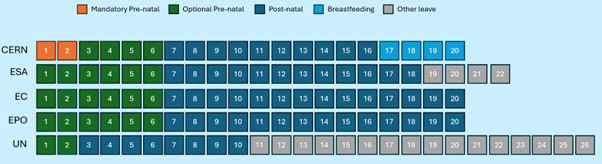 Figure 1 - Maternity leave policies in weeks
Paternity / Co‑parent Leave
The landscape of paternity leave has changed even more rapidly. Many organizations now provide between four and six weeks of leave for the non‑birthing parent. Importantly, nearly all organizations allow this leave to be taken flexibly within the first months after birth.
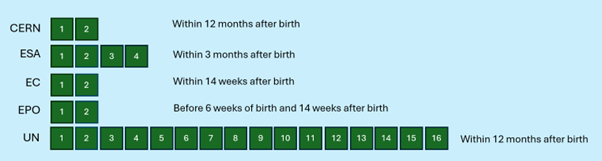 Figure 2 - Paternity/Co-parent leave policies in weeks
Parental Leave
Parental leave—offered in addition to maternity or paternity/co-parent leave—is where the largest disparities occur. Many European member states already provide extended parental leave of up to several years (e.g., Germany allows up to three years). Similar trends are emerging among international organizations:
- ESA, EC and EPO provide structured parental leave open to both parents, with various degrees of paid and unpaid arrangements.
- UNOG offers extended “Family Leave”.
- CERN offers parental leave but with limited duration and flexibility compared to its peers
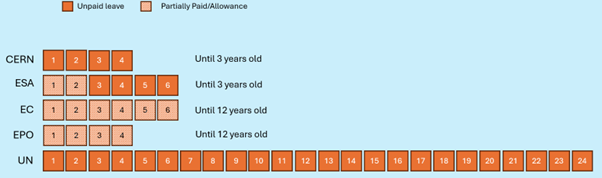 Figure 3 - Parental Leave Policies in months
Summary of the Staff Association Proposal
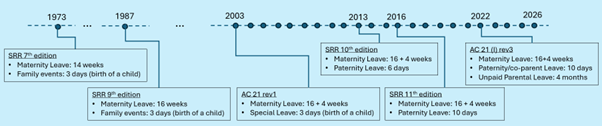 Figure 4 - Timeline of the introduction and evolution of maternity, paternity and parental leave policies at CERN in the Staff, Rules and Regulations and Administrative Circular 21
The Staff Association welcomes CERN management’s proposal, which represents a long‑awaited and much‑needed development. It has used this opportunity to suggest further improvements through the concertation process. The Staff Association key recommendations for these initial measures, were to extend the overall length and flexibility of family‑related leave, ensure more adaptable and supportive working arrangements for parents, and introduce fair contract‑extension measures so that maternity and paternity leave do not penalize staff on fixed‑term contracts.
Looking ahead, several areas require further study to ensure CERN’s family‑leave framework evolves in a fair and competitive way. These include exploring a continued increase in paternity leave with the long‑term goal of achieving parity with maternity leave, promoting genuine co‑parenting and reducing gender disparities. It will also be important to examine the mandatory nature of certain leave periods to avoid women being disproportionately penalized, professionally or socially. More broadly, future reflections should consider how policy design can minimize inequality, sharing caregiving responsibilities more evenly, and fostering a culture where all parents feel supported in balancing work and family life.
Sources
- UN Parental Leave and Family Leave - February 2023: https://docs.un.org/en/ST/AI/2023/2
- ESO Family Leave - February 2025: https://www.eso.org/public/jobs/conditions/intstaff/#family-friendly-support
- ESA Staff Regulations and Rules - January 2026: https://esamultimedia.esa.int/docs/LEX-L/Contracts/ESA_REG_007_rev_14_EN.pdf
- EPO Staff Rules - August 2025: https://link.epo.org/web/about-us/transparency-portal/en-epo-codex-service-regulations.pdf
- European Commission Staff Regulations – 2026: https://eur-lex.europa.eu/legal-content/EN/TXT/?uri=CELEX%3A01962R0031-20230101
- OECD Staff Rules and Regulations – 2026: https://www.oecd.org/content/dam/oecd/en/about/careers/Staff_Rules_and_Regulations_EN.pdf
- EUMET Staff Rules and Regulations – 2025: https://www-cdn.eumetsat.int/files/2025-07/44254 - Staff_Rules.pdf
- CERN Administrative Circular 21:
- AC 21 rev1: https://repository.cern/records/t2yw4-6jj30
- AC 21 rev2: https://repository.cern/records/ccryk-wxc49
- AC 21 rev3: https://repository.cern/records/3q4vc-nn642