
CERN Five-Yearly Review Survey: Focus on Graduate Priorities
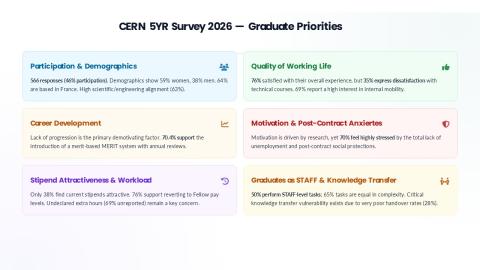
The key findings of the CERN Five-Yearly Review (5YR) survey and the Staff Association’s Graduate Discussion Forum in June 2026 have provided valuable insights into the experiences of graduates across the Organization. While the survey identified priorities affecting CERN as a whole, this article examines how contract limitations, workload pressures, and social protections affect graduates.
Contract Policy: The Primary Hurdle
Contract policy stands out as the most pressing issue for graduates. An overwhelming 82% of respondents believe the current contract policy reduces CERN's attractiveness. The lack of long-term career prospects has become the main source of demotivation for graduates.
Crucially, the survey also reveals a significant mismatch between responsibilities and employment status: half of the graduates feel they are carrying out work that they consider to be assigned to staff members, while 65% report handling tasks of comparable complexity and volume.
Workload, Recognition, and Career Development
Although nearly half of respondents (48.6%) are satisfied with their overall professional experience, the survey paints a more nuanced picture of day-to-day working conditions. Around 37% of graduates work additional hours, yet 69% of this overtime is neither reported nor compensated. Despite this, 57.1% express a willingness to work overtime or join on-call rotations if proper compensation were introduced.
Financial recognition also remains a concern: only 38% of respondents consider their stipend attractive, leading to 76% supporting a return to the previous "Fellow" income levels. Furthermore, 70.4% strongly support the implementation of a merit-based career progression system supported by annual performance reviews, to provide clearer development prospects.
Training, Support, and Workplace Equity
The survey highlights both strengths and areas for improvement regarding the working environment. 81% of the graduates feel comfortable asking their supervisor for help but 27% report receiving only occasional support and 11% say they receive insufficient support. Furthermore, knowledge transfer also appears to be a significant weakness: only 28% believe a proper handover is made between predecessors and successors, while 37% report no overlap at all. Training opportunities remain uneven, with only 51% report receiving training opportunities while 35% express dissatisfaction with technical courses, prompting calls for a dedicated training budget and formal work certificates.
The survey also highlights perceived inequalities, including gender, age, nationality and category-based discrimination, reinforcing calls for greater transparency and inclusion.
Social Protection and Post-Contract Anxiety
One of the most alarming findings is the stress associated with leaving CERN. A striking 70% of graduates report significant stress due to the absence of eligibility for unemployment benefits once their contract ends. To address this concern, graduates call for stronger social protection measures, including post-contract health and unemployment coverage, an improved pension transfer value, and the possibility of remaining affiliated with the CERN pension scheme after their contract ends.
Conclusion
The survey and the discussion forum provide a clear picture of the challenges graduates face and highlight concrete areas where targeted improvements could strengthen both their experience and CERN’s attractiveness as an employer: graduates are very often used as missing staff under poor employment conditions, which was not the program’s original aim. Addressing these concerns, and thus reviewing the program, would not only give recent graduates a genuine opportunity for training at the start of their careers but also contribute to sustaining the Organization’s ability to attract and retain talented young professionals.