
CERN Five-Yearly Review Survey: Focus on Students’ Priorities
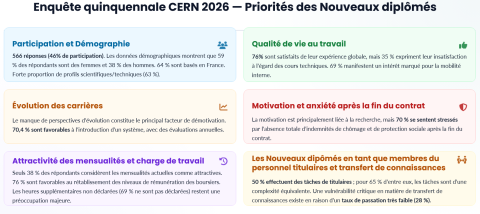
It is often said that young people are the future, and their voices should be heard. What, then, do young people working at CERN have to say? The Five-Yearly Review Survey gave them the platform: 205 students responded, 100 Doctoral Students (a 41% participation rate) and 105 Technical Students, Administrative Students and Trainee (31%).
Doctoral student contract duration
More than half of doctoral student respondents (51%) believe a three-year contract is insufficient to complete their PhD. They point to activities unrelated to their research imposed by CERN or the university, overly ambitious projects, and mental load. In fact, across CERN member states, a doctorate takes closer to five years than three [2-5]. Should CERN consider allowing extensions for doctoral contracts to align with universities’ requirements, with how long a doctorate does take in practice and the expectations of its own doctoral students?
The pay gap between studentship types
Subsistence allowance and financial benefits are at the top of the list of priorities for non-doctoral students, and the reason is not hard to find. A quarter of this group (25%) reports financial stress, and 24% rely on external financial support to cover living costs in the local area. How come? Technical and administrative students receive a monthly allowance of 3,486 CHF, while trainees receive 1,593 CHF - less than half [1]. How can such a discrepancy exist while both are supposed to be enough to live in the region for very similar profiles? Trainees are also excluded from the CERN Health Insurance Scheme. More than 62% of students report at over 795 CHF a month for rent: that is more than half the monthly subsistence allowance for trainees. The Staff Association has demanded that disparities between student contracts be mitigated, and we understand efforts, led by HR, are ongoing to rethink the student contracts. We will report on its progress.
Workload and mental health
Most students speak positively about their experience at CERN, but the detailed view is less comfortable. Two thirds of doctoral students (67%) consider their workload excessive, 39% work more than 40 hours a week always or often, and 44% work during the weekends. Among other students, 63% exceed 40 hours at least occasionally, and 24% call their workload excessive. This is a good moment to remind everyone that students cannot be compensated for extra hours - neither in money nor on leave. If you are a student, your supervisor should not require you to work beyond your contracted hours. If this happens, let us know, the Staff Association can defend your rights and help you. A culture that normalizes overwork undermines well-being at work and leads to mental health problems and, in some cases, burnout. One third of doctoral students report poor mental health and only 39% have enough personal time; among other students, the figures are 16% and 37%.
Training, development and supervision standards emerged just as strongly in the survey, and we will return to them in future communications.
Detailed reports on this survey, in French, are available at the Staff Association Secretariat; abridged versions in English are also available. We are drafting proposals to address the issues raised by the survey which we will present to management. We will keep you updated.
[1] Pay, Benefits, and Support – careers.cern - Accessed 28 August 2026. https://repository.cern/records/2grd2-3p074
[2] Austria: BMBWF, Universitätsbericht 2023, §8.1.3 - “Die durchschnittliche Studiendauer von Doktoratsstudien lag im Studienjahr 2021/22 bei 9,4 Semestern.” https://unibericht.bmbwf.gv.at/2023/99/
[3] Belgium: ECOOM, Vlaams Indicatorenboek, §3.2.4 “Time to degree”, data from Human Resources in Research Flanders - https://www.vlaamsindicatorenboek.be/3.2.4/time-to-degree
[4] France : https://www.enseignementsup-recherche.gouv.fr/sites/default/files/2025-…;
[5] Germany: Bundesbericht Wissenschaftlicher Nachwuchs 2021, Abb. B46, p. 138, Promotionsdauer 2018 nach Fächergruppen und Geschlecht