CERN Five-Yearly Review Survey: Staff Members Priorities in Focus
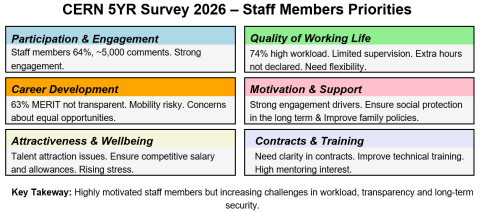
The Staff Association public meetings in June 2026 presented the key findings of the CERN 5-Yearly Review (5YR) survey. Covering staff members, graduates and associated members of the personnel (MPAs based at CERN for more than 50% of their time), the survey will help shape discussions on social conditions throughout 2026 and 2027.
Participation increased significantly compared with 2019, reaching 64% among staff members, 46% among graduates and 19% among MPAs. Around 7,700 open comments also provided valuable qualitative feedback. This article focuses on staff members' priorities.
Quality of Working Life: The Main Concern
Quality of working life emerges as the most pressing concern, with 74% of staff members reporting a high workload, particularly among women and administrative staff. This pressure is further compounded by organisational challenges, including limited managerial support: around 30% of supervisors report low availability, while 11% of staff say they receive no support at all.
Recognition remains an issue: half of staff members work extra hours, but only half of those hours are declared. Meanwhile, 68% of respondents would like greater flexibility in their working arrangements.
Career development: need for transparency and fairness
Many staff members question the transparency of the MERIT system. Nearly two-thirds (63%) believe it lacks transparency, while around 60% feel career progression depends largely on managerial decisions.
Support for change is strong: 59% favour recognising collective achievements and up to 70% support 360-degree evaluations. Internal mobility is widely encouraged (71%), yet 40% still view it as a career risk.
The survey also highlights perceived inequalities, including gender, age, nationality and category-based discrimination, reinforcing calls for greater transparency and inclusion.
Motivation, social protection, and family support
Despite these concerns, motivation remains high. More than 80% of respondents cite autonomy, meaningful work and collaboration as key drivers of engagement.
At the same time, staff members expect stronger support systems. Priorities include safeguarding pensions and health insurance, improving parental leave, and increasing childcare support for young children.
Attractiveness, compensation, and wellbeing
A large majority (74.3%) believe CERN faces difficulties attracting highly skilled personnel from all member states. Staff members also call for compensation that better reflects inflation and market realities.
While around 80% enjoy their work and feel well integrated, stress levels have risen significantly since 2018.
Contracts and training: clarity and development opportunities
Contract policy remains another major concern: 78% want greater transparency, 73% associate current policies with increased job insecurity, and 86% support opening positions earlier to improve knowledge transfer.
Training is generally well rated, although technical training could be strengthened. Interest in development opportunities remains high, with many respondents expressing interest in mentoring and formal certification.
Looking Ahead
The survey reveals a workforce that remains highly motivated and committed to CERN's mission. However, concerns about workload, transparency, career development and long-term security need to be addressed to maintain CERN's attractiveness and excellence.